
Quality You Expect, Commitment You Deserve
Blog Detail
Nitrosamines in organic chemistry
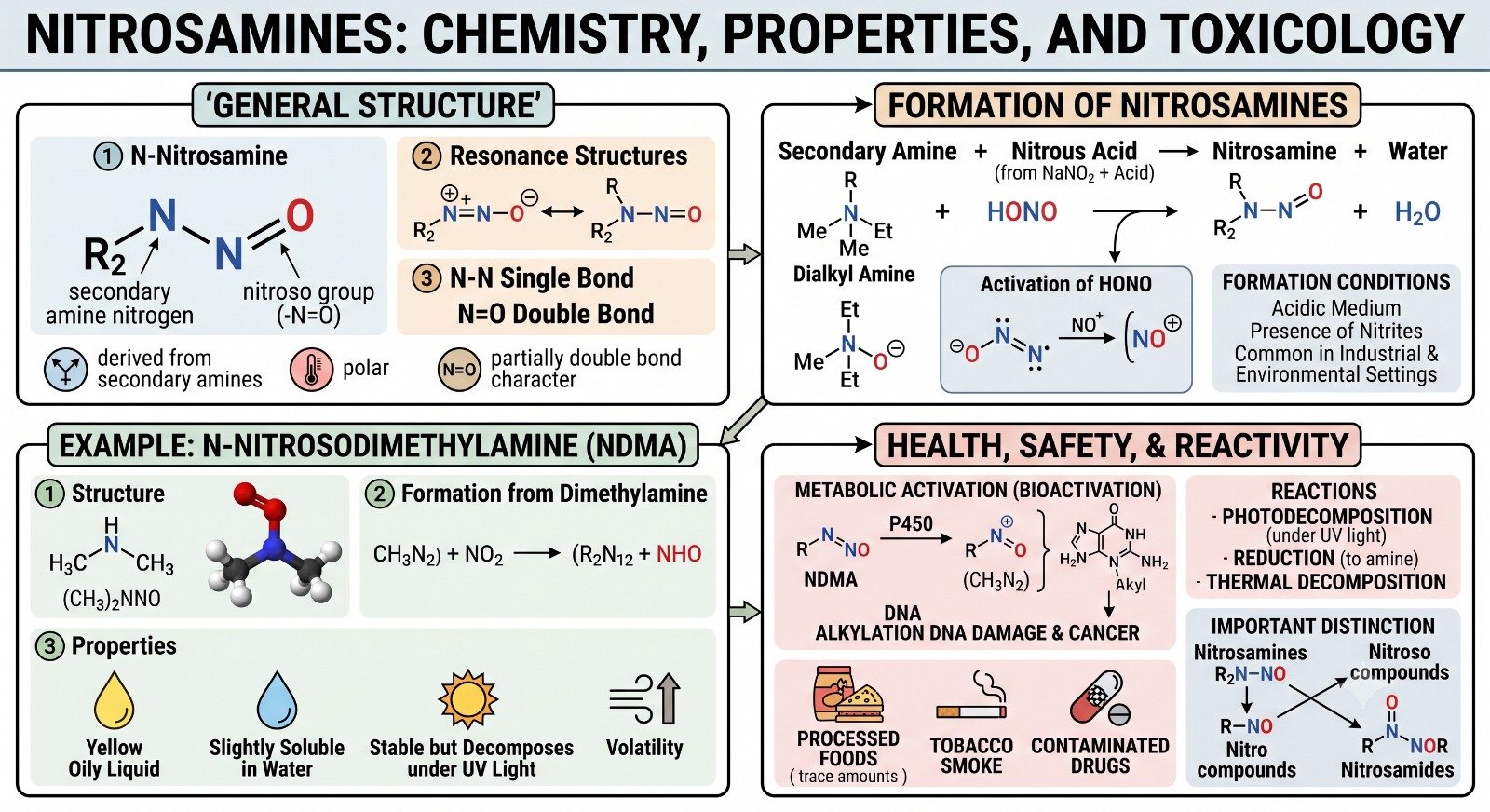
Nitrosamines in organic chemistry
Including structure, properties, formation, and one example.
Nitrosamines in Organic Chemistry
Nitrosamines are an important class of nitrogen-containing organic compounds that contain the nitroso functional group (–N=O) bonded to an amine nitrogen. They are widely studied in organic chemistry, toxicology, and pharmaceuticals.
What is a Nitrosamine?
A nitrosamine is formed when a nitroso group (–N=O) is attached to a nitrogen atom of an amine.
👉 General structure:
R₂N–N=O
This means:
Derived mainly from secondary amines
Contains an N–N bond with a nitroso group
Structural Features
Nitrosamines show distinctive structural characteristics:
N–N bond linking amine and nitroso group
Presence of N=O double bond
Can exhibit resonance stabilization
Key effects:
Moderate stability
Polar nature
Ability to participate in chemical transformations
Why Are Nitrosamines Important?
Nitrosamines are significant because they:
Occur in industrial and environmental chemistry
Are found in food preservation processes (trace amounts)
Play a role in pharmaceutical safety studies
Are studied for their toxic and carcinogenic properties
Formation of Nitrosamines
Nitrosamines are typically formed by nitration of secondary amines.
Reaction:
Secondary amine + Nitrous acid (HNO₂) → Nitrosamine
👉 Conditions:
Acidic medium
Presence of nitrite salts (like NaNO₂)
Example:
N-Nitrosodimethylamine (NDMA)
Structure
(CH₃)₂N–N=O
This is one of the most well-known nitrosamines.
Formation
Dimethylamine + Nitrous acid → N-Nitrosodimethylamine
Properties
Yellow, oily liquid
Slightly soluble in water
Stable under normal conditions
Can decompose under UV light
Example Reaction
Photodecomposition:
N-Nitrosodimethylamine → breaks down under UV light → forms reactive intermediates
Health and Safety Aspects
Nitrosamines are widely studied due to their health effects:
Many are carcinogenic (cancer-causing)
Can damage DNA
Found in:
Processed foods (in small amounts)
Tobacco smoke
Some contaminated drugs
👉 Because of this, strict regulations exist in pharmaceutical industries.
Reactions of Nitrosamines
Common reactions include:
Reduction → secondary amines
Photolysis → decomposition under light
Thermal decomposition
Hydrolysis (in some cases)
Important Distinction
Do not confuse nitrosamines with:
Nitroso compounds (R–NO)
Nitro compounds (R–NO₂)
Nitrosamides (R–CO–N(NO)–R')
Each has different structures and reactivity.
Key Takeaways
Nitrosamines have the general structure R₂N–N=O
Formed by nitrosation of secondary amines
Chemically stable but biologically harmful
Important in organic chemistry and toxicology
Heavily regulated due to carcinogenic nature
Releted Blogs
Nitrosamines in organic chemistry
Discover the chemistry of nitrosamines: general structures, formation mechanisms, key properties, and practical examples like NDMA. Learn why they matter in toxicology and pharmaceuticals.